You're about to create your best presentation ever

Tabbed Presentation Template

Create your presentation by reusing one of our great community templates.

Tabbed Email

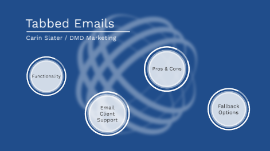
Transcript: Tabbed Emails Carin Slater / DMD Marketing Functionality Functionality Tabs are a method of creating interactive emails that contain information hidden in tabs that can be activated by the user. Tabbed Email in Action Tabbed Email in Action Email Client Support Email Client Support The coding used to create this effect is not supported in all email clients iOS & Apple Mail iOS & Apple Mail iOS and Apple Mail support tabbed emails 70% Of opens from DMD's database are on iOS devices or Apple Mail AOL Mail AOL Mail AOL Mail supports tabbed email 1.6% Of opens from DMD's database are on AOL Mail (or AOL Desktop) Yahoo! Mail Yahoo! Mail Yahoo! Mail supports tabbed emails 3.2% Of opens from DMD's database are on Yahoo! Mail Outlook Outlook Outlook does not support tabbed emails 9% Of opens from DMD's database are on Outlook (2007 - 2016) Gmail Gmail Gmail does not support tabbed emails 3.9% Of opens from DMD's database are on Gmail (or a Google Android device) Pros & Cons Pros & Cons Pros Pros Interactive emails have showing to increase unique click rates by as much as 18%. Interactivity in emails is the number one growing trend in email marketing. Cons Cons And now the bad news... Clicks within email not trackable Adding CTAs within each tab enables a degree of tracking Tabs are not supported across all email clients Designing a fallback helps keep the email looking good, even in email clients that don't support tabs. Fallback options allow for content to be displayed asthetically no matter what email client the email is opened on Fallback Options Fallback Options Show 1st Tab Content Show 1st Tab Content The content in the first tab is shown by itself as a fallback. Show All Tabbed Content Show All Tabbed Content Show all content stacked one ontop of another. Alternative Content Alternative Content Alternative content can be displayed to encourage the user to view the email in a browser window to get the full exerience.

TABBED BAR APPLICATION

Transcript: Launch Screen Create a tab application that has: notifications sound app icon tab icons launch screen vibration iAds InAppPurchase Facebook Open a new project and delete those old viewcontrollers.h and .m because they can't read table views... SOUND! Challenge! Developer License, Certificates and Provisioning Profiles avc.h Saving a String Advantages: ObjC API Sounds can be any duration Source can be file, memory or stream Can play multiple sounds at once Can play in the background Can monitor info better Disadvantages: No precise timing Limited access to audio data limited ability to alter stream This was commented out Attempt the following: tvc.m So, a delegate in iOS development, is kind of like the idea of a delegate in real life, in politics, or in business. It's a formal way that one person can entrust responsibilities to another person. For us as developers, delegation is a formal way that one object can entrust work to another object. Many classes in iOS, including built in classes like the provided user interface elements. Take care of a lot of their own normal internal processing. The Social App iOS Objective C Development TableViewController.h Twitter Create a random PList Application that will give you an inspirational quote. ViewController.h tvc.m Delegate IRL We set up the editing style and made sure that the row that was deleted goes away. and set up an error for ourselves. When it deletes it gives us a nice animation AVFoundation But they can also be connected to your objects, your view controllers, or even completely custom classes. And can delegate certain responsibilities to those objects, just passing over some of their capabilities so that other object can take care of it. tvc.m An instance of NSManagedObjectContext represents a single “object space” or scratch pad in an application. Its primary responsibility is to manage a collection of managed objects. These objects form a group of related model objects that represent an internally consistent view of one or more persistent stores. A single managed object instance exists in one and only one context, but multiple copies of an object can exist in different contexts. Thus object uniquing is scoped to a particular context. Life-cycle Management The context is a powerful object with a central role in the life-cycle of managed objects, with responsibilities from life-cycle management (including faulting) to validation, inverse relationship handling, and undo/redo. Through a context you can retrieve or “fetch” objects from a persistent store, make changes to those objects, and then either discard the changes or—again through the context—commit them back to the persistent store. The context is responsible for watching for changes in its objects and maintains an undo manager so you can have finer-grained control over undo and redo. You can insert new objects and delete ones you have fetched, and commit these modifications to the persistent store. All objects fetched from an external store are registered in a context together with a global identifier (an instance of NSManagedObjectID) that’s used to uniquely identify each object to the external store. tvc.m //this was commented out An NSManagedObjectModel object describes a schema—a collection of entities (data models) that you use in your application. The model contains one or more NSEntityDescription objects representing the entities in the schema. Each NSEntityDescription object has property description objects (instances of subclasses of NSPropertyDescription) that represent the properties (or fields) of the entity in the schema. The Core Data framework uses this description in several ways: Constraining UI creation in Interface Builder Validating attribute and relationship values at runtime Mapping between your managed objects and a database or file-based schema for object persistence. A managed object model maintains a mapping between each of its entity objects and a corresponding managed object class for use with the persistent storage mechanisms in the Core Data Framework. You can determine the entity for a particular managed object with the entity method. You typically create managed object models using the data modeling tool in Xcode, but it is possible to build a model programmatically if needed. Challenge! CHALLENGE avc.m Naming starts with the name of the NSObject doing the delegation, which is then followed by a verb that describes what the object is doing, such as did, will, should, or has. Let's take another object that we've all seen before, UIScrollView. It has a delegate protocol that you can adhere to as well, and it has delegate methods such as: scrollViewDidScroll, scrollViewWillBeginDragging, and so on and so forth. If I were to have a custom object named car, and I wanted to be informed of what happens when the car starts or stops, I'd probably name its delegate methods carDidStart, carWillStart, carHasStarted, carDidStop, and carWillStop. addviewcontroller.m avc.m These

Presentation Template

Transcript: Designing Your Presentation Structuring Content Effectively Color Schemes and Fonts Choosing the Right Layout Incorporating Visuals and Graphics A clear structure is vital for effective presentations. The rule of three can be applied, presenting ideas in groups of three for easier digestion. Use bullet points and numbered lists to enhance clarity and flow. Color schemes set the mood and enhance readability. A limited palette of 2-3 colors with contrasting tones is more effective. Choose fonts that align with the presentation tone; sans-serif for modern looks and serif for traditional presentations are common choices. The layout determines visual hierarchy and readability. Common layouts include slides designed for text-heavy content versus those emphasizing visuals, such as images or infographics. A well-structured layout improves audience retention of information. Visuals, such as images and charts, capture attention more than text alone. Research shows that visuals can improve information retention by up to 65%. Infographics help in simplifying complex data for better understanding. Introduction to Research Topic Templates serve as a blueprint for presentations, providing consistency in design and structure. They save time and ensure that crucial elements are not overlooked, enhancing overall communication and engagement with the audience. Components of a Good Template A good presentation template includes essential elements such as a title slide, content layout, visual hierarchy, and consistent color schemes. Each component must work together to enhance readability and visual appeal, guiding the audience through the information seamlessly. Types of Presentation Templates There are various types of presentation templates including pitch decks, educational lectures, and marketing presentations. Each type is tailored to specific communication needs and audience expectations, ensuring clarity and relevance of the content. Best Practices for Presentations Visual Aesthetics in Templates Visual aesthetics, including color theory and typography, play a crucial role in presentation templates. Effective use of visuals can capture attention, reinforce messages, and promote retention, making the information more impactful. Relevance of the Current School Curriculum to future job market Demands Engaging Your Audience To capture attention, incorporate storytelling, relevant anecdotes, and interactive polls or questions. Research shows that audiences are 75% more likely to remember presentations that include interactions. Timing and Pacing Utilizing Technology and Tools Leverage tools like PowerPoint, Prezi, or interactive platforms such as Mentimeter for effective visuals and engagement. Utilizing technology not only makes your content more dynamic but also enhances understanding across diverse learning styles. Effective presentations balance content with timing. Aim for 1 minute per slide on average and leave time for questions; experts recommend 10-15% of total time for Q&A to enhance understanding and engagement. Handling Questions and Feedback Encourage questions by allocating specific time for audience interaction and demonstrating openness. Implementing a structured Q&A format can improve clarity and allows for deeper audience engagement while addressing common misconceptions. Conclusion and Next Steps Resources for Further Learning Recap of Key Points For those looking to refine their presentation skills, consider books like 'Presentation Zen' by Garr Reynolds and online courses on platforms such as Coursera or LinkedIn Learning. These resources offer advanced techniques and strategies for effective communication. Essential components of effective presentations include understanding your audience, utilizing engaging visuals, and structuring content for clarity. A well-designed template can significantly enhance the presentation experience for both the presenter and the audience. Call to Action for Practice Final Thoughts on Presentation Skills Mastering presentation skills not only enhances professional opportunities but also boosts personal confidence. Remember, effective communication is a key asset in any field, making it essential for career advancement. Regular practice is vital for mastery in presentations. Engage in public speaking groups like Toastmasters or seek opportunities to present at work to build confidence and receive constructive feedback.

Template Presentation

Transcript: Focus on the United States and Global Perspective Global Reactions to Chinese EVs Future Trends and Conclusions Market Entry of Chinese EVs Consumer Sentiments and Branding American consumers are generally optimistic about Chinese EVs, focusing on affordability, technology, and environmental benefits. However, brand trust remains a challenge, as perceptions of Chinese manufacturing quality influence buying decisions in the competitive US market. The future of Chinese EVs in the US indicates a sustainable trajectory, driven by rising fuel prices and supportive regulations. This growth, alongside increasing collaborations between Chinese firms and US tech companies, positions Chinese EVs to potentially reshape the automotive landscape in the coming years. Chinese electric vehicle manufacturers, such as BYD and NIO, are strategically entering the US market, targeting environmentally conscious consumers and leveraging technological advancements. Their entry is marked by partnerships and investments, indicating a commitment to competing in a rapidly evolving EV landscape. Global Overview Introduction to Chinese EVs China has emerged as the world's largest electric vehicle market, driven by government incentives, robust manufacturing capabilities, and increasing consumer demand. Chinese brands like BYD and NIO are becoming significant players on the global stage, challenging traditional automakers. Market Growth and Trends The global EV market is projected to grow exponentially, with Chinese manufacturers playing a pivotal role. Innovations in battery technology and autonomous driving are accentuating this growth, influencing international supply chains and manufacturing norms. International Responses Countries worldwide are reacting to the rise of Chinese EVs with varied approaches. While some nations are collaborating with Chinese manufacturers to enhance EV adoption, others are imposing regulations to protect their local industries, leading to a complex geopolitical environment. A Comprehensive Overview of International Perspectives Market Dynamics in Australia and the EU Focus on China China's EV Market Landscape Australia: Market Adoption China's EV market has experienced exponential growth, accounting for over 50% of global EV sales in recent years. The country boasts a diverse range of manufacturers, from startups to established automakers, continually innovating to meet increasing consumer demands for sustainable transportation. The adoption of Chinese EVs in Australia has been on the rise, driven by competitive pricing and increasing consumer awareness. Major brands like BYD and SDAR are capturing a growing segment of the automotive market as Australians prioritize sustainable transport solutions. Regulatory Environment Government Policies and Support Both Australia and Germany are implementing regulations to encourage EV adoption. Australia is focusing on reducing tariffs and providing incentives, while Germany emphasizes emissions targets and subsidies to transition towards electric mobility. Consumer Preferences The Chinese government has implemented aggressive policies to promote EV adoption, including subsidies, tax exemptions, and substantial investment in charging infrastructure. These initiatives aim to reduce urban pollution and decrease oil dependency, contributing to the nation's green energy goals. Challenges in Adoption Australian consumers are showing a strong preference for cost-effective, environmentally friendly vehicles. A recent survey indicates that price and safety are key considerations in purchasing decisions, with a favorable view of Chinese manufacturers introducing affordable options. Key Industry Players Despite favorable conditions, challenges remain for Chinese EVs in both markets. Issues such as charging infrastructure, consumer trust, and brand recognition hinder traction, requiring strategic efforts from manufacturers to overcome these barriers. Germany’s Competitive Landscape Major players in China's EV market include BYD, NIO, and Xpeng, all of which are rapidly expanding their product lines and improving battery technology. Their innovation and competitive pricing strategies help maintain China's dominance in the global EV landscape, as they increasingly target international markets. Germany, as a leader in the European automotive sector, faces stiff competition from Chinese EV manufacturers. Brands like NIO and Xpeng are gaining traction, prompting local manufacturers to innovate and enhance their offerings to maintain market share.

Now you can make any subject more engaging and memorable